Strategic IT Consultancy for SMEs: How Roadmapping Fuels Growth
Strategic IT consultancy helps SMEs move from reactive break-fix support to planned, scalable technology operations. In 2026, that means building an IT infrastructure roadmap that supports growth, strengthens cyber resilience, aligns with ITIL 4 service governance, and prepares the business for supply chain scrutiny linked to NIS2, DORA, and ESG reporting expectations.
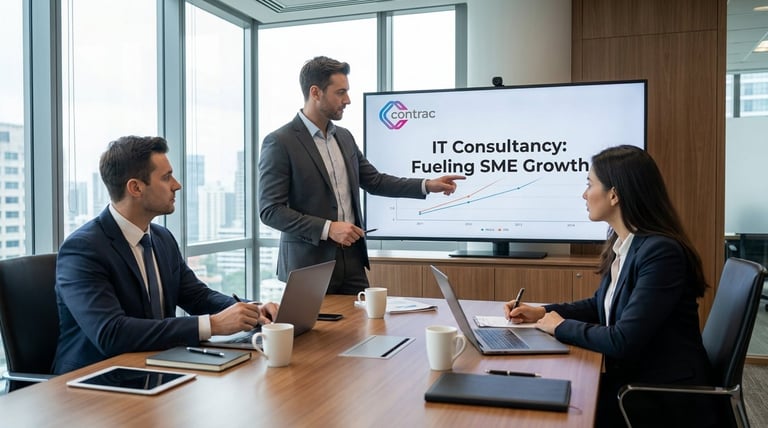
For many business owners, the ‘IT person’ is still someone they call when something stops working. They appear when the internet is down, a laptop will not boot, or an application refuses to load.
That view is now too limited for any SME with growth plans.
True IT consultancy is not only about fixing what is broken. It is about understanding where the business needs to be in three years, assessing the current technology baseline, and building the technical operating model to support that ambition. The goal is to reduce risk, improve service quality, and ensure every technology investment supports measurable business outcomes.
In 2026, that matters more than ever. SMEs are being asked to prove cyber resilience, operational continuity, data governance, and sustainability standards before they can win or retain larger contracts. Strategic IT consultancy gives leaders a practical roadmap for meeting those expectations without overbuying, overcomplicating, or relying on accidental IT decisions.
Strategic IT consultancy moves SMEs beyond break-fix support
Reactive support still has a place. Incidents must be resolved quickly, users need responsive help, and day-to-day IT issues should not distract teams from serving customers.
But break-fix support is not a growth strategy.
Strategic IT consultancy looks at the business as a whole. It reviews systems, workflows, security controls, service levels, data flows, vendor relationships, and commercial objectives. It asks where technology is creating friction, where risk is accumulating, and where the organisation will outgrow its current model.
For a scaling SME, this shift is significant. Instead of waiting for systems to fail, consultancy creates a structured plan for improving them. That plan can include cloud adoption, network modernisation, cyber security controls, Microsoft 365 optimisation, endpoint management, backup strategy, business continuity, and procurement governance.
At its best, consultancy becomes an extension of the internal IT team. It gives leadership access to strategic guidance, technical architecture, and operational support without requiring the business to build every capability in-house.
Breaking the technical glass ceiling of legacy systems
Many SMEs do not flatline because sales demand disappears. They slow down because the operating model cannot cope with growth.
This is the technical glass ceiling.
It appears when teams rely on manual data entry between disconnected platforms. It appears when permissions are inconsistent, reporting is unreliable, or a server begins to struggle every time more users are added. It also appears when business-critical knowledge sits with one person who understands how the systems were assembled over time.
Accidental IT is expensive. It usually starts with sensible short-term decisions: one tool for finance, another for sales, another for stock control, another for reporting. Over time, those tools form a fragmented environment that is hard to secure, hard to support, and hard to scale.
An IT consultant identifies those bottlenecks before they become critical. They review workflows, map dependencies, assess infrastructure capacity, and identify where automation can remove repetitive manual effort. This may mean integrating core applications, consolidating licences, retiring duplicate tools, or moving from isolated spreadsheets to a governed cloud platform.
The outcome is not technology for its own sake. It is time returned to the business, fewer operational errors, better reporting, and a platform that can support the next phase of growth.
Building an ITIL 4 aligned infrastructure roadmap
A strong technology roadmap should do more than list projects. It should define the operating principles that guide future IT decisions.
For growing SMEs, ITIL 4 provides a useful framework. It encourages businesses to think in terms of service value, governance, change enablement, incident management, continual improvement, and measurable outcomes. That is the difference between buying tools and building a service model.
An ITIL aligned infrastructure roadmap should answer practical questions:
Which services are business critical?
What availability, support, and recovery targets are required?
Who owns each system, supplier, licence, and data set?
How will changes be assessed, approved, tested, and rolled back?
Which platforms should be standardised, integrated, or retired?
What controls are needed before the business scales into new markets or larger contracts?
This is where enterprise-grade thinking becomes valuable for SMEs. A roadmap helps avoid overpaying for features that are not needed today while preventing underinvestment in foundations that will become critical tomorrow.
It also creates a common language between leadership, finance, operations, and IT. Instead of treating technology as a series of one-off purchases, the business can manage it as a portfolio of services with defined risk, cost, ownership, and value.
The enterprise metric that matters is mean time to restore service (MTRS): a roadmap should define who owns an incident, how it is escalated, and which systems must be recovered first.
Regulatory resilience is now a growth requirement
In 2026, compliance pressure is no longer limited to large enterprises. SMEs are increasingly assessed through the lens of their customers, investors, insurers, and supply chain partners.
Directives and frameworks such as NIS2 and DORA are raising expectations around cyber security, operational resilience, incident reporting, supplier assurance, and business continuity. An SME may not always be directly in scope, but it can still face contractual requirements from larger organisations that must prove control across their supply chain.
That means technology maturity can influence whether an SME wins business.
Strategic IT consultancy helps prepare for this scrutiny by creating evidence-based controls. This can include documented asset registers, access control policies, backup testing, disaster recovery planning, vulnerability management, security awareness training, incident response processes, and supplier risk reviews.
It also helps leaders understand the gap between current practice and expected assurance. Rather than reacting to an audit request at the last moment, the business can build resilience into its operating model and provide clearer evidence when customers ask how data, services, and systems are protected.
Enterprise-grade security starts with Zero Trust principles
For many SMEs, cyber security used to mean antivirus, a firewall, and a password policy. That is no longer enough.
Modern environments are distributed. Users work across offices, homes, customer sites, shared networks, cloud platforms, SaaS applications, and mobile devices. The old assumption that everything inside the network is trusted does not fit the way businesses now operate.
Zero Trust architecture is built on a simple principle: never assume trust, always verify. In practical SME terms, that means applying controls such as multi-factor authentication, least privilege access, conditional access, device compliance checks, endpoint detection, secure identity management, privileged account controls, logging, and regular access reviews.
A consultant can help prioritise these measures based on risk. Not every organisation needs the same tooling or the same level of complexity. The objective is to reduce the likelihood of compromise, limit the impact if an account or device is breached, and provide evidence that security controls are being managed.
This is where consultancy and managed support should work together. Strategy defines the required control state. Support keeps it operating through monitoring, patching, user administration, incident management, and continual improvement.
Sustainable IT and ESG reporting are becoming board-level issues
Technology decisions now have a sustainability dimension. Hardware lifecycle, energy consumption, cloud utilisation, e-waste, procurement standards, and supplier reporting can all affect the environmental profile of an organisation.
For SMEs that sell into larger organisations, ESG expectations can increasingly arrive through procurement questionnaires and supplier due diligence. CSRD reporting requirements apply directly to larger businesses, but those businesses often need data and assurance from their supply chains.
Strategic IT consultancy helps SMEs make better decisions in this area. It can identify underused infrastructure, consolidate workloads, improve device lifecycle management, standardise procurement, and create clearer records for asset disposal and refresh planning.
This is not only about reporting. Sustainable IT can also reduce operating costs. Rightsized cloud resources, efficient endpoint management, longer planned hardware lifecycles, and better procurement governance all help reduce waste while improving control.
From cost centre to profit driver
The purpose of consultancy is to change the conversation around IT spend.
A reactive model frames IT as a necessary cost. Something breaks, someone fixes it, and the invoice is treated as overhead. A strategic model connects IT investment to business value: faster onboarding, reduced downtime, better security, stronger customer assurance, lower licensing waste, improved productivity, and more predictable service performance.
When systems are stable, data is protected, and teams have the right tools, the return shows up across the business. Sales teams can access better customer information. Finance can report with greater confidence. Operations can reduce manual work. Leadership can make decisions using cleaner data. Customers can see that the business takes resilience seriously.
The question is no longer whether IT costs money. The better question is whether technology is helping the business grow safely, efficiently, and credibly.
How Contrac supports SME growth: Consult, Transform, Support
Contrac works as an agile extension of your internal IT team, using a structured Consult, Transform, Support methodology.
Consult begins with discovery. We assess your current environment, business objectives, risks, suppliers, service levels, and operational pain points. This establishes a practical baseline for decision-making.
Transform focuses on delivery. That may include infrastructure modernisation, cloud migration, cyber security improvement, endpoint standardisation, process automation, procurement alignment, or service management improvement.
Support keeps the model working. Through managed service delivery, incident management, monitoring, change control, user support, and continual improvement, the roadmap becomes a living operational framework rather than a static document.
For SMEs with growth ambitions, this approach provides the structure needed to scale without losing control. It also gives customers, auditors, insurers, and enterprise buyers greater confidence that the business can protect data, maintain service continuity, and meet agreed expectations.
Is your technology built for the business you have today, or the business you want to become? A strategic IT consultancy engagement can help you answer that question with a roadmap that reduces risk, supports growth, and prepares your organisation for 2026 and beyond.
Frequently Asked Questions
Build an IT roadmap that supports growth and reduces risk
Contrac helps SMEs assess their current environment, modernise infrastructure, strengthen cyber resilience, and maintain ITIL aligned service operations through a practical Consult, Transform, Support model.
Explore IT Consultancy